Exhibitions — Group
an[other]space
Date20 May – 25 June 2026
Locationan[other]space, OLOMOPOLO, 43A Block D New Muslim Town, Lahore, Pakistan.
Featured in "Fugitive Bodies, Speculative Borderlands" Group Exhibition in Lahore, Pakistan
We are proud to announce that Syowia Kyambi is participating in the upcoming group exhibition, Fugitive Bodies, Speculative Borderlands (مفرور افراد ، فرضی منطقه حرم), opening at OLOMOPOLO in Lahore, Pakistan. Curated by Abdullah Qureshi and co-presented by an[other]space and OLOMOPOLO, the exhibition runs from May 20th to June 25th, 2026.
Bringing together a powerful cohort of international artists—Tamara Al-Mashouk, Sara Khan, Syowia Kyambi, Sandeep Johal, and Risham Hosain Syed—the exhibition highlights critical, diverse, and transnational decolonial feminist perspectives. Fugitive Bodies, Speculative Borderlands reflects on the historical erasures, movements, and representations of racialized and migratory subjects. The curator frames the artists' visual approaches through Saidiya Hartman's (2008) concept of Critical Fabulation: a method that strains against the constraints of the archive to recover the unknowable, disrupt official narratives, and imagine alternative worlds. Moving through drawing, video, textiles, and installation, the exhibition invites viewers to inhabit the borderland not just as a site of violence and rupture, but as a fertile space for imagination and transformative solidarity.
Kyambi will be presenting three multi-layered bodies of work that interrogate archival presence, domestic class structures, and the psychological disruptions of diaspora:
- Rose's Relocation (2015): This series features five digital photo collages that blend two distinct sets of images. The first highlights Rose, a fictional character created for Kyambi's performance installation Fracture (i), while the second comprises black-and-white photographs of rural Kenya taken in 2010 representing the fictional memories of Rose's mother's home. Developed during a residency at the Fonds Régional d'Art Contemporain Lorraine in Metz, France, the superimposed imagery evokes the isolation, loss, and conflicting definitions of success that shape life in the diaspora.
- Kaspale's Archive Intrusion (The Lightbox Series, 2026): Presented via digital collages inside wooden-framed lightboxes, this project emerged out of Kyambi's 2019 residency at the MARKK Museum in Hamburg. Kyambi directly engages with late 19th- and early 20th-century photographs taken by German zoologists at a colonial research station in Amani, Tanzania. She introduces Kaspale—a fictional, fluid trickster character named through a hybrid blend of German, Kiswahili, and Sheng—who actively "intrudes" into the imagery to disrupt colonial nostalgia, expose institutional power, and render the archive unstable.
- Between Us (2013): This 1:38-minute video installation is an excerpt from a multi-output trilogy that probes social conventions and boundaries between public and private spaces. The work centers heavily on the figure of the servant—the unseen watcher, cleaner, and fixer who quietly maintains the social order. In the context of the exhibition, this character occupies a liminal position, navigating the delicate borderlands between service, surveillance, and survival.
Exhibition Information
- Exhibition Title: Fugitive Bodies, Speculative Borderlands (مفرور افراد ، فرضی منطقه حرم)
- Exhibition Dates: May 20th – June 25th, 2026
- Venue: OLOMOPOLO, 43A Block D New Muslim Town, Lahore, Pakistan
- Curator: Abdullah Qureshi
- Co-Presenters: an[other]space and OLOMOPOLO Media
For sales or inquiries regarding the exhibited artworks and Limited Edition Prints, please contact an[other]space.
Curatorial Note
Over the last year, the programming at an[other]space has focused on highlighting critical and diverse artistic practices, emphasizing decolonial feminist and transnational perspectives. Our previous exhibitions, Gathering Grounds (Ijtimai Buniadain)(October 2025) and Tidal Paths (نقش مدوجزر)(February 2026), expanded upon María Lugones’ (2010) concept of feminist border thinking, and her call to challenge historical and ongoing systems of coloniality through strategies of learning/unlearning together and coalition-making. They considered collaborative and collective ways of coming together and holding space, as well as notions of remembering, refusal, and repair to examine issues of gender, sexuality, race, migration, and social justice.
Fugitive Bodies, Speculative Borderlands (مفرور افراد ، فرضی منطقه حرم) builds upon the programming at an[other]space to reflect on the historical erasures, representations, and movements of racialized and migratory subjects, and their capacity to conjure powerful wayward worlds. The exhibition extends Gloria Anzaldúa’s (1987) articulation of the borderland as a politically charged and productive terrain to visually enact outlaw modes of relation and possibility, and generate powerful alternative narratives and therwise imaginaries.
Here, I see speculation as distinct from pure fiction or from constructing fantasies disconnected from the lived realities and experiences of historically and systemically marginalized subjects. Rather, I suggest that the use of speculative strategies in the presented artists’ work should be understood through the lens of Saidiya Hartman’s (2008) concept of Critical Fabulation: a method that strains against the limits of the archive to narrate other histories, recover the unknowable, disrupt official accounts, rearrange narrative elements, and imagine what might have happened.
The presented artists–Tamara Al-Mashouk, Sara Khan, Syowia Kyambi, Sandeep Johal, and Risham Hosain Syed–engage with a range of visual approaches, including archival research, fieldwork, and myth-making, to unsettle histories and geographies of control. Through drawing, painting, photography, textiles, video, and installation, they foreground gestural acts of resistance, survival, and rearticulation, providing pathways to envision more just futures and solidarities. The exhibited artworks resist fixed understandings of identity, territory, and belonging, instead tracing fluid and fugitive modes of being that emerge through displacement, memory, intimacy, and refusal. In doing so, the exhibition invites viewers to consider inhabiting the borderland not only as a site of violence and rupture, but also as a space of imagination, relationality, and transformative possibility.
Abdullah Qureshi
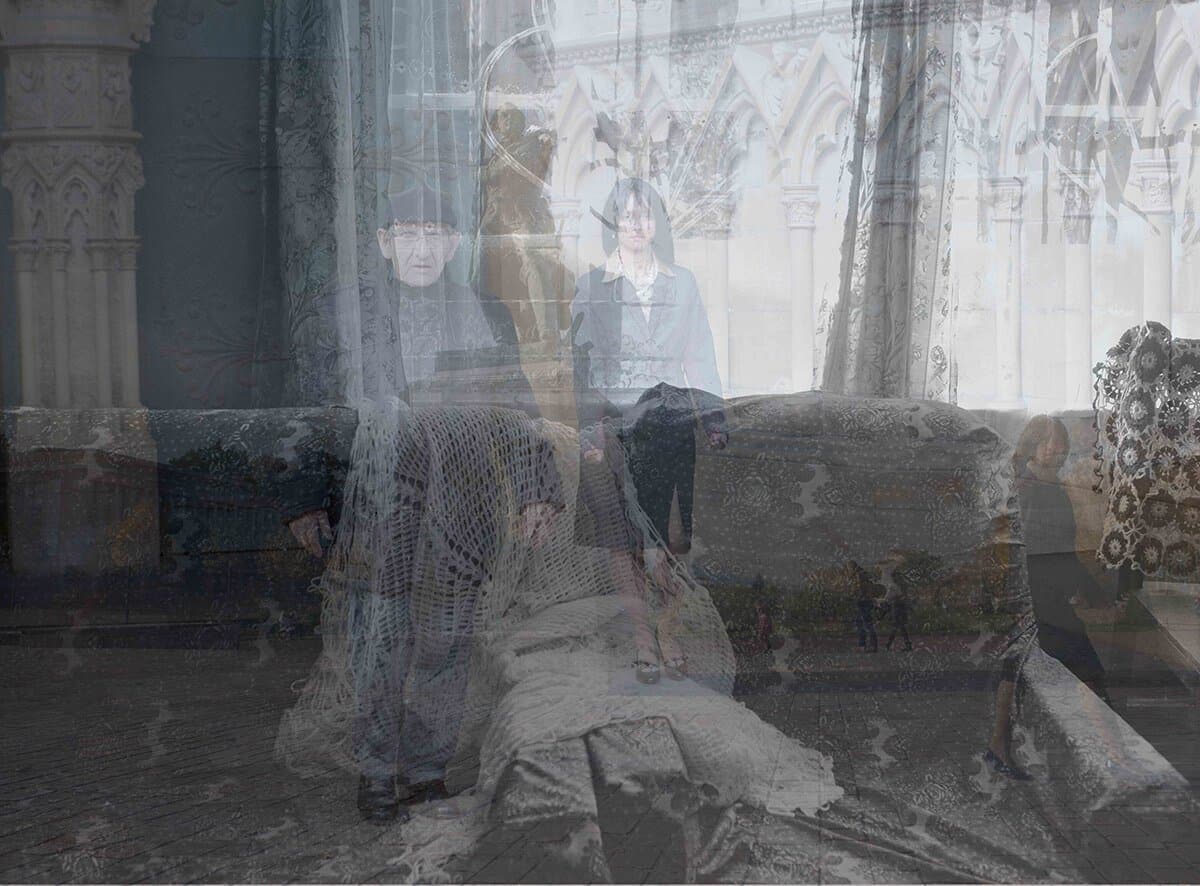
Syowia Kyambi, Rose’s Relocation (i-v), Digital C-Type / Fuji Matt Paper. 28.2cm x 38.2cm (each). Edition of 5 & 1AP. 2015
© Syowia Kyambi. All rights reserved.